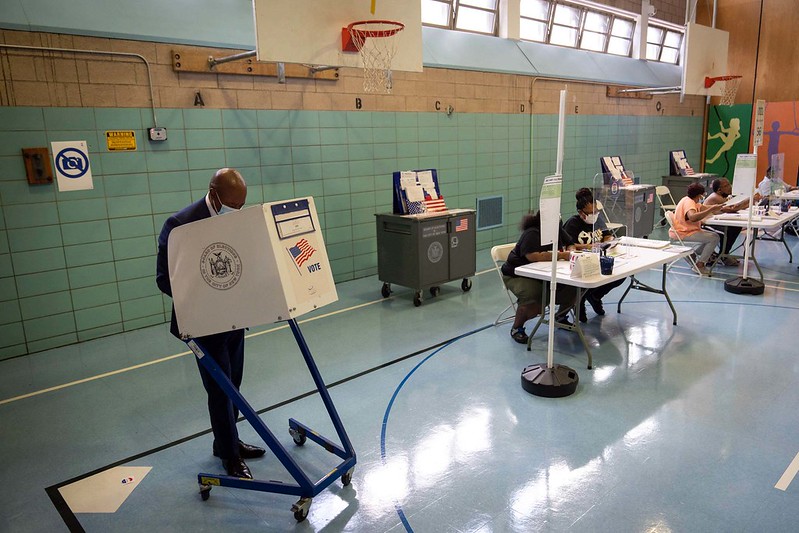
After years of discussion about new voting machines will the February presidential primary mark the last time New York voters use the Shoup lever machines? It will if the Justice Department has its way.
While every other state has transitioned to the use of new voting machines mandated by the 2002 Help America Vote Act (HAVA), New York still has not complied with the federal law. Some experts argue that this has been ultimately a good thing because it enables New York to learn from the mistakes and mishaps of other states that have already started to use electronic voting machines. However, recent action by the federal Department of Justice may mean any lessons learned will be lost in attempts to force New York to get new machines -- and get them fast.
Obstacles to New Machines
Through HAVA the federal government required that by 2006 all states adopt new accessible voting machines that would, among other things, allow voters with disabilities to cast their ballots independently and privately. New York missed that deadline. Now on the brink of a presidential election as well as contests for Congress and New York State Legislature, the state still is struggling to find a machine that complies with its own stringent regulations, as well as federal requirements. The federal Election Assistance Commission’s suspension of Ciber, Inc., the firm hired by New York State to test the machines, further hampered the process.
After numerous delays and missed deadlines, the U.S. Justice Department filed a motion in November that calls for full implementation of new voting machines in New York State by September 2008. The latest move comes in the federal government’s ongoing lawsuit against the state, which began when New York failed to meet the January 1, 2006 deadline for new accessible voting machines.
As part of the suit, New York worked out an agreement allowing it to place one ballot marking device in each county so disabled voters would have access to voting machines that allowed them to vote privately and independently. That system also was used in 2007.
The State Board of Elections was to produce a new plan for HAVA implementation last month. Splitting along party lines, it submitted two proposals to the court. The one put forth by the board’s Democratic commissioners called for one ballot-marking device in every poll site by September 2008 along with continued use of the state’s lever machines. It also called for a new voting system by 2009. The Republican plan proposed continued use of ballot marking devices in 2008 and until new voting machines are selected and set no timelines for a new voting system.
Will Haste Make Waste?
Citing the state’s failure to produce one cohesive plan for implementation, the department’s motion calls on the court to either assume control of the machine selection process for the state or assign a party to do so. This would take control out of hands of the state Board of Elections.
State and county election officials as well as voting reform advocates fear the Department of Justice’s push for implementation of new voting technology by next September will force New York to buy voting machines that fail to meet state law. Local Board of Elections officials argue that implementation of an entirely new voting system in less than a year would be nearly impossible, as the boards would have to bring all poll sites up to standards to accommodate the new machines and train poll workers on how to use the new voting technology.
Some local officials are reluctant even to place ballot-marking devices at every polling location by the presidential election. The New York City Board of Elections has estimated it would cost approximately $40 million to put a marking device in each poll site across the five boroughs. Some advocates argue that the cost could pose a particular problem if a county eventually decides to purchase a voting system that is not compatible with the devices.
In addition, some legislators and advocates contend that forcing the state to purchase new machines with less than a year to prepare for their use could threaten the security of the voting process. Last month, City Councilmember Simcha Felder spoke against the Justice Department proposal saying the plan "to force New York to use voting machines that have proven to cause problems in other states is outrageous."
Groups like NYPIRG, Brennan Center, Citizens Union (whose sister organization publishes Gotham Gazette) and the League of Women Voters have also chimed in to caution against the hasty implementation plan proposed by Washington. The organizations argue that New York State has among the toughest requirements for voting machines in the nation. Compromising now by purchasing voting technology that has had problems in other states would not necessarily be the right move for the state and voters.
" I understand where they DOJ is coming from, and I am particularly concerned with the fact that the state has been so slow to ensure that disabled voters have the same opportunity that other voters do to cast a vote privately and independently as in other states," said Larry Norden of the Brennan Center. "On the other hand the wholesale replacement of lever machines with a voting system that hasn’t been properly tested seems foolhardy."
Many groups have echoed the sentiment that, while they would applaud an interim voting plan more accessible to disabled voters and would ideally like to see an accessible voting system that meets state standards implemented as soon as possible, using machines that do not meet the strict requirements in state law would be unwise, particularly during a presidential election.
With so many issues still up in the air and plans for new voting machines having made little progress in the past year, it is hard to know what the general election in 2008 will look like. As the months pass and November 2008 draws nearer, it appears increasingly less likely that New York will purchase new machines and have them operational for the entire state by then. "I don’t see the rationale for forcing New York to implement a plan that might create chaos on Election Day next year," Norden said.
For those New Yorkers who have been waiting to kiss the Shoup lever machines good-bye, you may have to wait a little longer.
Andrea Senteno is program associate for Citizens Union Foundation, which publishes Gotham Gazette. Â