Ask most housing advocates what one move would improve the lot of tenants in New York City, and they would answer: Repeal of the Urstadt Law. The state law, which then-Governor Nelson Rockefeller pushed through in 1971, and which Governor George Pataki strengthened in 2003, is named after Rockefeller’s housing commissioner, Charles Urstadt. For more than three decades, it has effectively handcuffed the city when it comes to dealing with the main problems facing housing here -- rents and evictions.
That is because the law largely took control of rent regulation out of the hands of the city government and gave it to the state legislature. The legislature, a body with many representatives from upstate districts that have few renters, has weakened rent regulation laws year after year. Changes in the rent regulation laws have resulted in what some estimate to be more than 100,000 rent stabilized apartments in New York City becoming “decontrolled” – the rents hiked up to whatever the landlord wants to charge.
Advocates say repealing the Urstadt Law would give the city the power to keep rents affordable.
“In my mind, it is the only way to reverse the crippling of the rent and eviction protections that we’ve seen at the hands of the state legislature,” said Kenny Schaeffer, vice chair of the Metropolitan Council on Housing. “Right now, the City Council’s hands are tied. The rent stabilization laws have had so many holes poked in them by the state legislature that they’re dying a death of a thousand cuts.”
Revoking the city’s control over rent laws was a strategic political move Rockefeller made to help in his re-election campaign, recalled Michael McKee, associate director of Tenants and Neighbors. As a result, it led to four sets of laws that fill hundreds of pages noted for their complexity, if not incomprehensibility.
There are state rent control laws and city rent control laws, state rent stabilization laws and city rent stabilization laws. Over the years, these have been revised and sometimes rewritten. Some of the laws are specific to New York City while others apply to smaller cities. The laws have spawned thousands of pages of commentary and doubtless assured the employment of many attorneys, legal journalists and, yes, even housing advocates. It takes years to figure out just what the different laws say and how they are applied in practice
Reclaiming home rule over rents and evictions would make understanding those laws easier, McKee said, in addition to making housing advocates’ work less onerous.
“We have a rent regulation system that makes no sense at all,” McKee said. “It’s a patchwork quilt that no one understands.”
Repealing the Urstadt Law would not create a “paradise” for tenants, McKee said, but would help them be more effective.
“Tenants will still have to organize and put pressure” on elected officials, McKee said. “But at least we won’t have to fight a two-front war. Especially in years where the (state’s and city’s) laws sunset at the same time. From an organizers point of view it’s a nightmare. People say, â€I thought the laws just got renewed, why do I have to go to Albany?’”
Political considerations could make a repeal of the Urstadt Laws possible this year, Schaeffer said. Record homelessness, high rents and the continued loss of rent regulated apartments have put affordable housing firmly on the political agenda and the mayoral election will only increase the pressure for solutions.
At the same time, Democrats scored significant victories in last November’s elections to diminish the Republican majority in the State Senate. Those victories have led Senate Majority Leader Joseph Bruno to compromise more readily on progressive issues. A higher minimum wage and less draconian drug crime punishments are some of the results of the new political realities for Bruno.
While Mayor Michael Bloomberg has said in the past he supports a repeal of the Urstadt Law, McKee noted that he was silent when Pataki strengthened the law in 2003. Tenants have not forgotten, he said.
“Even when Pataki pushed, there wasn’t a squawk from the mayor, he didn’t say a word,” McKee said. “And we are fed up with this posturing in City Hall.”
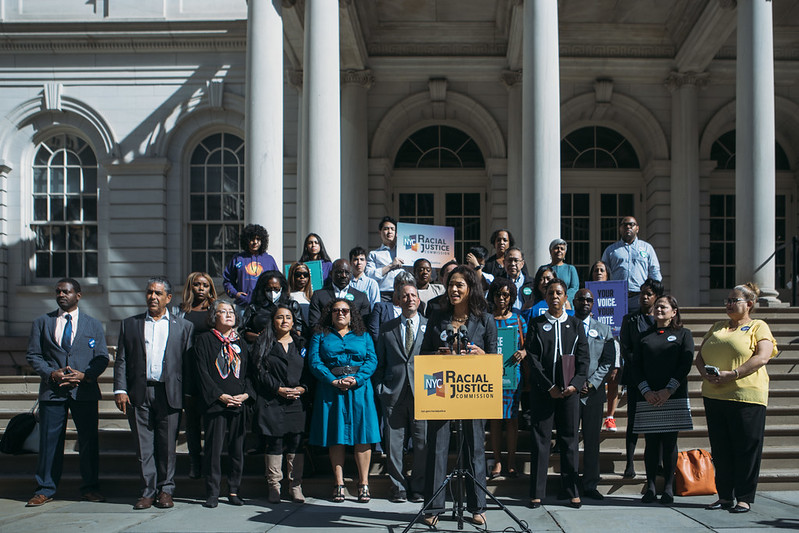
 People gather at City Hall February 2 in support of affordable housing and in protest of the Urstadt Law. |
A rally planned for Feb. 2 is meant to send that message loudly and clearly to politicians. The rally on Brooklyn Bridge will call attention to affordable housing, and specifically three actions that would allow the city to address the problem: Making sure that a significant portion of Battery Park Authority funds actually finance affordable housing construction as originally intended; Persuading the city to adopt inclusionary zoning that would allow developers to build higher density developments in return for setting aside a percentage of the units for affordable housing; And calling for a repeal of the Urstadt Law.
Joe Lamport is the assistant director of the City-Wide Task Force on Housing Court, a coalition of community housing organizations.